
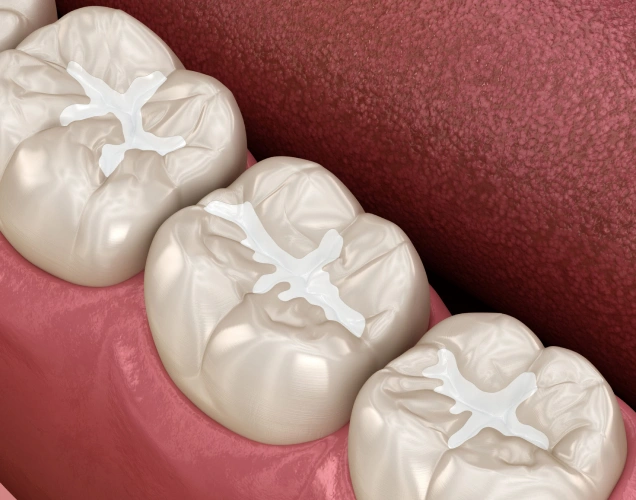
Protect Your Smile With Sealants
Are you or a loved one looking for preventative dental care that can help in the fight against tooth decay and cavities? Then look no further than Inspire Smiles! We offer dental sealants, an excellent way to maintain good oral hygiene and protect teeth from bacteria. Our team of dental professionals will thoroughly examine and then apply the sealant that provides a barrier on top of your enamel, preventing plaque & food particles from accumulating there. Visit our dental practice today and learn how dental sealants can help keep your smile healthy!
How Fluoride and Sealants Can Protect Your Teeth
Fluoride toothpaste brushing and flossing are essential dental hygiene routines that can help prevent cavities. Nevertheless, it can be challenging to adequately clean every nook and corner of your mouth. The bristles on a toothbrush sometimes can't go all the way into the gaps of your teeth, especially those molars that help you chew food when you eat. In the microscopic crevices of your teeth, residual food particles and bacteria that cause cavities remain, creating the ideal environment for tooth decay.
A mineral called fluoride can strengthen enamel and stop tooth decay in its tracks. On your teeth's deep cracks and gaping holes, fluoride is less protective. Thankfully, dental sealants are a fantastic fix for this issue.
What Are Dental Sealants?
A dental sealant is a very thin, protective layer that is bonded to the chewing surface of your molars or back teeth. It is made of resin-plastic or another dental material. By properly filling in the fissures and pits in the teeth, cavities can be prevented. On the chewing surfaces of molars, sealants are significantly more efficient at preventing cavities than fluoride alone is.
Who is Eligible for Dental Sealants?
Cavities can be prevented from the beginning when teeth are sealed as soon as they erupt into the mouth, which will ultimately save time, pain, and money. Sealants are generally given to children and teenagers because tooth decay can start as soon as teeth erupt and because most decay in youngsters affects the chewing surfaces of molars.
Sealants can also help people who have a greater risk of developing cavities because cavities can happen at any age (such as those who have dry mouth, a poor diet, a history of tooth decay, or other conditions). Even though sealants can be helpful for both adults and children, it is best to get them when a child is still a small child. Sealants can be put on baby and adult molars. Yet, when applied to permanent teeth, they are most affordable.

How Do Sealants Function?
A sealant is easily and painlessly applied. Your dentist Richmond can apply the sealant to each tooth in only a few minutes without the use of anesthesia. The following are the procedures for placing dental sealants:
- The teeth that will be sealed are carefully cleaned by your dentist.
Each tooth will be dried and placed in an absorbing material such as cotton. - The application of a mild etching solution will result in the teeth's chewing surfaces being rougher. Because of the rough surfaces, the sealant will stick to the teeth more effectively.
- The solution is removed after a brief period, and the tooth is then dried once again. The tooth's surface pits and cracks are then coated with sealant.
- Certain sealants self-harden in about a minute. When the dentist uses the curing light to apply the sealant, some are "light-cured" and harden more quickly.